

Clear vision often begins with one practical decision: choosing the right Single Vision Lenses for a person’s prescription, lifestyle, and frame. A cyclist may need crisp distance vision outdoors. A reader may need comfortable near focus under warm desk lighting. The “best” lens is rarely identical for everyone.
The World Health Organization’s World Report on Vision states that at least 2.2 billion people have near or distance vision impairment worldwide. It also identifies unaddressed refractive error as a major contributor. That finding gives lens selection real importance, not just commercial appeal. Market reports from Grand View Research also describe continuing growth in ophthalmic lenses, supported by prescription changes, aging populations, and demand for thinner, lighter designs.
Dr. Mark Rosenfield, a professor of vision science, explains, “A refractive error occurs when the eye cannot focus light precisely on the retina.” His point is simple. Accurate measurement must come before coatings, materials, or brand comparisons.
This guide reviews 10 Single Vision Lenses through practical criteria, including optical clarity, lens thickness, scratch resistance, ultraviolet protection, digital-use comfort, and value. It considers high-index materials for stronger prescriptions and polycarbonate options for impact-sensitive users. However, no ranking can replace a professional eye examination. That limitation matters.
Some recommendations may change after real-world use. A lens that feels light in a showroom may seem reflective near a window. A premium coating may still disappoint without careful cleaning. The best choice combines clinical guidance, verified specifications, and honest expectations.
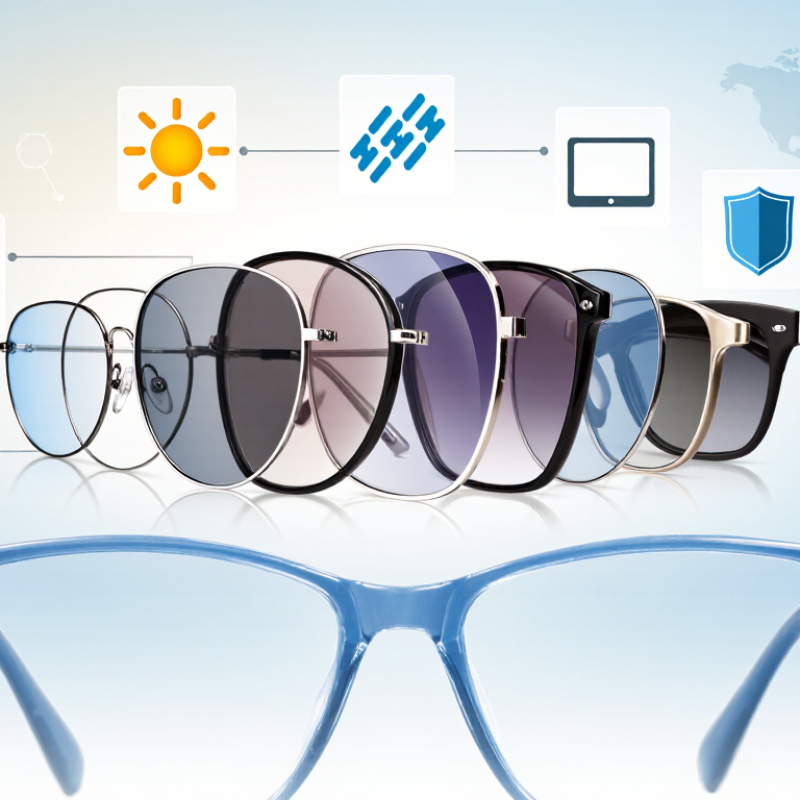
Single vision lenses correct one viewing distance: far, intermediate, or near. Their prescription stays consistent across the entire lens. This design helps people with nearsightedness, farsightedness, or astigmatism see more clearly. A driver may need distance lenses, while someone reading printed documents may need near lenses.
They are often suitable for children, students, office workers, and adults who need separate glasses for different tasks. An eye examination determines the prescription, not guesswork or an old pair of glasses.
During a fitting, an optician also checks pupil position, frame size, and how the lenses align with your eyes. Small measurements matter. Even a strong prescription can feel uncomfortable when the frame sits poorly.
Lens material depends on prescription strength, lifestyle, and safety needs. People who spend hours outdoors may benefit from ultraviolet protection, while frequent screen users may prefer a lens design that reduces distracting reflections.
These features do not replace regular vision care. Some people adapt within a day; others notice blur, pressure, or headaches and need an adjustment.
I have found that “best” is rarely universal. A slim lens may look attractive, yet it might not suit every prescription or budget. A careful discussion with a qualified eye-care professional usually produces a more practical choice.
Choosing among the 10 best single vision lenses requires more than selecting the highest refractive index. Lens material, design, and optical clarity affect comfort in different ways. The World Health Organization’s World Report on Vision estimates that at least 2.2 billion people live with near or distance vision impairment. Accurate prescriptions and careful fitting therefore matter as much as lens selection.
Material changes visual performance. Standard optical plastic often provides a relatively high Abbe value, around 58, which can reduce color fringes at the lens edge. Polycarbonate is lighter and impact-resistant, but its Abbe value is commonly near 30. High-index materials can make strong prescriptions thinner, yet they may show more chromatic blur. Aspheric or atoric designs can reduce thickness and improve peripheral vision, but poor centration can cancel those benefits. There is no perfect lens.
Tips: Ask for the material’s Abbe value, refractive index, and measured optical center. Confirm monocular pupillary distance and fitting height. The ISO 8980-1 standard addresses finished spectacle lens performance, but real-world clarity also depends on frame position, prescription accuracy, and cleaning habits. A 2023 report from The Vision Council found that eyewear remains a common method for correcting vision, reinforcing the value of professional dispensing. Still, choosing solely by thinness is a mistake. Your daily tasks, screen distance, prescription strength, and sensitivity to glare should guide the final comparison.
| No. | Lens Material and Design | Typical Refractive Index | Approximate Abbe Value | Optical Clarity | Relative Weight | Impact Resistance | Best Use Case | Main Advantages | Important Limitations |
|---|---|---|---|---|---|---|---|---|---|
| 1 | High-quality CR-39 with spherical design | 1.50 | Approximately 58 | Excellent | Medium | Moderate | Low to moderate prescriptions where natural visual quality and value are priorities. | High Abbe value, low chromatic aberration, good transparency, and generally economical. | Thicker and heavier than high-index materials for stronger prescriptions; not ideal for active or hazardous environments. |
| 2 | Trivex with aspheric or atoric design | 1.53 | Approximately 43–45 | Very high | Light | Very high | Children, sports eyewear, rimless frames, and users needing a strong balance of clarity and safety. | Lightweight, highly impact-resistant, and optically clearer than many high-index plastics. | Usually thicker than 1.60–1.74 materials for high prescriptions; may cost more than basic plastic. |
| 3 | 1.60 high-index with aspheric design | 1.60 | Approximately 40–42 | Very high | Light to medium | High | Moderate prescriptions requiring thinner lenses without a major compromise in visual quality. | Noticeably thinner than 1.50 plastic, relatively light, and suitable for many everyday prescriptions. | Chromatic aberration is higher than in CR-39 or Trivex; premium anti-reflective treatment is recommended. |
| 4 | 1.67 high-index with atoric design | 1.67 | Approximately 31–33 | High | Light | High | Moderately strong prescriptions where lens thinness, edge appearance, and weight matter. | Thinner and lighter than 1.60 material; atoric surfaces can improve peripheral performance and reduce distortion. | Lower Abbe value can produce more noticeable color fringes, especially away from the optical center. |
| 5 | 1.74 high-index with atoric or freeform design | 1.74 | Approximately 33–34 | High | Very light | High | Strong prescriptions where maximum available thinness and reduced lens protrusion are important. | Usually the thinnest plastic option; high refractive index can improve cosmetic appearance in powerful prescriptions. | More expensive, lower chromatic performance than CR-39, and highly dependent on accurate measurements and lens centration. |
| 6 | Polycarbonate with aspheric design | 1.586 | Approximately 30 | Good | Light | Very high | Safety eyewear, children’s glasses, sports use, and environments with elevated impact risk. | Excellent impact resistance, light weight, built-in ultraviolet protection, and compatibility with many safety frames. | Lower Abbe value may cause more chromatic aberration; surface scratches can be a concern without a hard coating. |
| 7 | Freeform digital single vision lens | Usually 1.50–1.74 | Depends on material | Very high | Depends on material | Depends on material | Users seeking optimized peripheral vision, especially with larger frames, oblique prescriptions, or higher powers. | Computer-controlled surface customization can improve off-axis clarity and adapt the lens to frame geometry. | Performance depends on prescription accuracy, fitting measurements, design quality, and proper frame adjustment. |
| 8 | Aspheric single vision lens | Usually 1.50–1.67 | Depends on material | High | Depends on material | Depends on material | Plus prescriptions, moderate-to-high powers, and users who want flatter lenses with less magnifying appearance. | Flatter profile, reduced center thickness in many plus prescriptions, and improved appearance compared with basic spherical designs. | May require more precise optical centration; peripheral performance varies with the specific design and prescription. |
| 9 | Atoric single vision lens | Usually 1.60–1.74 | Depends on material | Very high | Light to very light | High | Moderate-to-strong prescriptions with astigmatism, where better peripheral sharpness and a flatter profile are desired. | Uses different curvature strategies across the lens to manage unwanted astigmatism and improve off-axis vision. | More expensive than standard spherical designs and sensitive to inaccurate pupillary-distance or fitting-height measurements. |
| 10 | Mineral glass single vision lens | Approximately 1.52–1.90 | Approximately 30–60, depending on composition | Excellent | Heavy | Low to moderate | Users who prioritize exceptional scratch resistance and stable optical performance over low weight and impact safety. | Very good optical transparency, excellent scratch resistance, and strong resistance to many surface chemicals. | Heavier and more breakable than plastic materials; generally unsuitable for children, sports, and impact-prone activities. |
How to compare: Material choice affects thickness, weight, impact safety, and chromatic aberration. Lens design affects peripheral clarity and appearance. For most prescriptions, accurate pupillary-distance and fitting measurements, an appropriate anti-reflective coating, and a well-adjusted frame are essential for achieving clear vision.
Choosing single vision lenses depends on where clarity matters most. The World Health Organization’s World Report on Vision estimates that at least 2.2 billion people have near or distance vision impairment. The Vision Council’s 2023 Consumer inSights Report also found that about 76% of U.S. adults use vision correction. The right lens deserves careful fitting.
For everyday distance or reading, standard 1.50 plastic offers affordable clarity. Polycarbonate and Trivex suit active users because they resist impact. Trivex is often lighter. For stronger prescriptions, 1.60, 1.67, and 1.74 high-index lenses reduce thickness. Photochromic lenses darken outdoors, but they may react less inside cars. Polarized lenses cut reflected glare from wet roads and water. Occupational single vision lenses support intermediate computer distances. Aspheric lenses can reduce bulging and improve edge appearance. Blue-filtering options remain debated; current evidence does not clearly prove better eye comfort.
Tips: Ask for your exact working distance, not only “computer use.” Compare thickness at the frame edge. Confirm impact standards, such as ISO 14889, for safety eyewear. An anti-reflective coating may improve night contrast, but it can scratch without proper care. Never choose only by price. Prescription strength, frame size, pupil position, and daily environment can change the result. Some recommendations sound convincing, yet personal testing is still useful.
This chart compares representative refractive index and Abbe values for commonly used single-vision lens materials. A higher refractive index generally supports thinner lenses, while a higher Abbe value is associated with fewer color fringes. Actual values can vary by formulation and lens design.
Standard plastic and crown glass typically provide strong optical clarity. Trivex and polycarbonate are commonly selected when impact resistance is important, while 1.67 and 1.74 high-index materials are often considered for stronger prescriptions requiring thinner lenses. Photochromic and polarized options depend on their underlying lens material.
Choosing among the 10 best single vision lenses starts with the wearer, not a glossy feature list. Prescription accuracy, pupillary distance, and frame fit strongly influence comfort. The World Health Organization’s World Report on Vision estimates that at least 2.2 billion people have vision impairment worldwide. Precise correction is a practical safety issue. An experienced optician should also check binocular alignment and working distance.
For comfort, compare aspheric designs, suitable lens index, and anti-reflective performance. Thinner lenses may reduce edge weight, but high-index materials can reflect more light without proper coating. Choose scratch resistance tested against recognized standards. No coating is scratch-proof. Polycarbonate and other impact-resistant materials suit active users. ANSI Z87.1 compliance matters for occupational protection, yet ordinary prescription lenses are not automatically safety eyewear.
UV protection deserves a clear number.
UV400 or 99–100% UVA and UVB filtration provides a useful benchmark, supported by professional optometric guidance. ISO 8980-3 offers a technical framework for measuring ultraviolet transmittance in spectacle lenses. The CDC’s Vision and Eye Health Surveillance System documents widespread uncorrected vision problems in American adults.
I still see people choose the thinnest lens first. That shortcut can disappoint. A lens may look elegant but feel heavy, glare-prone, or fragile. My fitting experience suggests comfort remains personal; screen distance, humidity, and daily activity can change the result.
Choosing single vision lenses starts with your daily visual needs, not the cheapest option. Distance prescriptions suit driving and outdoor viewing, while near prescriptions support reading and detailed work. Computer users may need a prescription measured for an intermediate range. An optometrist or qualified optician can check refraction, pupillary distance, and frame position. Fit matters.
Lens material also deserves attention. High-index materials can reduce thickness for stronger prescriptions, while impact-resistant materials may suit active lifestyles. Ask about scratch-resistant and anti-reflective treatments, especially if headlights or screens bother you. These features help, but they do not remove every reflection. I once assumed a coating would solve all night-glare problems. It did not. Eye dryness, dirty lenses, and poor lighting mattered too.
Clean lenses with lukewarm water and a small amount of mild lotion-free soap. Dry them with a clean microfiber cloth, not a shirt sleeve or paper towel. Tiny fibers can leave scratches. Store glasses in a hard case when they are not being worn. Avoid hot cars, steam, and household glass cleaners, which may damage lens coatings. Check the frame regularly for loose screws or uneven arms. If vision becomes blurry, headaches continue, or scratches interfere with sight, schedule a professional inspection. Do not keep using an outdated prescription simply because the lenses still look clear. Small details count.