What Are the Top Types of CR39 Lenses for 2026?
As 2026 approaches, Cr39 Lenses remain relevant in a market increasingly shaped by lightweight materials, digital prescriptions, and visual comfort. CR-39, a thermosetting allyl diglycol carbonate resin, offers clear optics, reliable tint absorption, and a familiar balance between cost and performance. It is not the newest lens material. That is part of its strength.
The World Health Organization’s World Report on Vision estimates that at least 2.2 billion people live with near or distance vision impairment. It also identifies unaddressed refractive error as a major concern. This context keeps dependable prescription lenses commercially important, especially in value-focused optical markets. Meanwhile, Grand View Research and other eyewear market analysts continue to report growth in prescription eyewear, although most reports group CR-39 with broader plastic lens categories. That limitation matters. Exact CR-39 market figures are difficult to verify.
This guide examines the leading types expected to attract attention in 2026. These include standard clear lenses, tinted lenses, polarized options, photochromic designs, and specialty coatings for glare or screen-heavy environments. Each type responds to a different daily scene: a clear lens under office lighting, a gray tint beside a bright road, or a polarized lens reflecting sunlight from water. Professional practice still requires prescription accuracy, coating compatibility, and proper fitting. Product labels alone are not enough.
Some buyers may expect blue-light features to solve digital eye strain. Evidence remains mixed, and better screen habits may matter more. That uncertainty deserves honest attention. Drawing on WHO guidance, optical manufacturing knowledge, and current industry reporting, this article compares practical choices rather than chasing fashionable claims.
What CR-39 Lenses Are and Which Properties Define Them
CR-39 lenses are lightweight plastic lenses made from allyl diglycol carbonate, a thermoset resin developed for optical use. Their refractive index is about 1.50, with an Abbe value near 58. This usually provides clear vision and low color distortion, especially for moderate prescriptions. The material also weighs less than glass. That difference is noticeable on the nose after several hours.
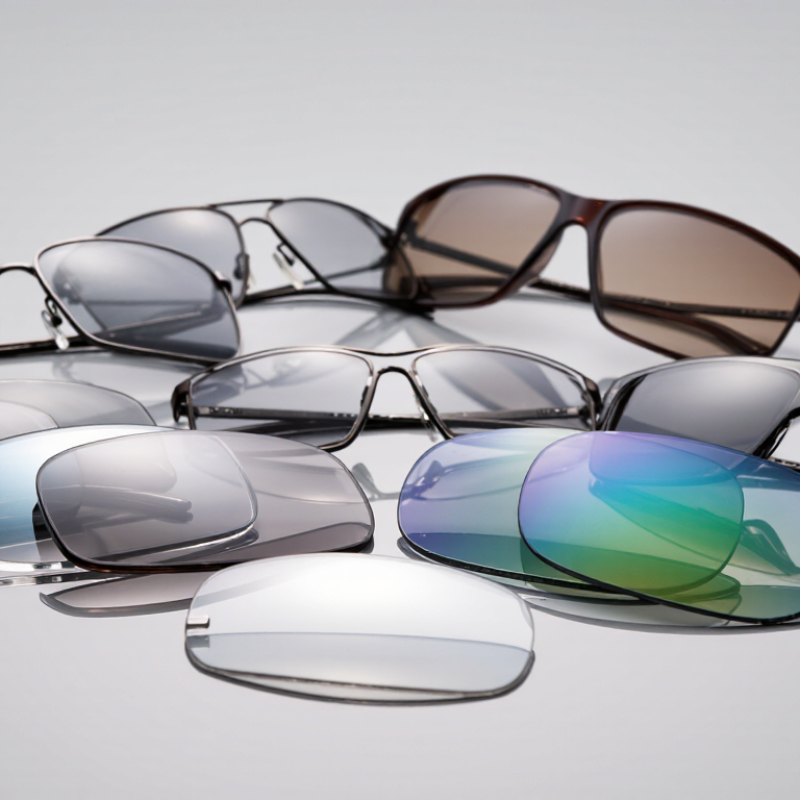
The main CR-39 types include clear, tinted, photochromic, and polarized designs. Clear lenses suit everyday indoor wear and often deliver the most natural color perception. Tinted versions reduce brightness, while photochromic lenses darken outdoors and remain lighter indoors. Polarized CR-39 lenses can reduce reflected glare from roads, water, and windows. Each option changes the lens experience, not just its appearance. UV protection depends on the formulation and treatment, so it should be verified rather than assumed.
Scratch-resistant and anti-reflective coatings can improve daily durability and night-time comfort. Still, CR-39 is not the toughest lens material. It offers less impact resistance than several modern alternatives, making it a poor choice for certain safety-focused activities. Edge thickness may also become obvious with stronger prescriptions. A skilled optician should consider prescription power, frame shape, pupil position, and working distance before recommending it. The trade-off is easy to miss: excellent optical clarity does not guarantee the best fit for every wearer.
Which Prescription Lens Designs Use CR-39
What Are the Top Types of CR39 Lenses for 2026?
CR-39 remains suitable for several prescription lens designs. Single-vision lenses are the most common choice for distance, reading, or computer correction. They provide clear optics and can support many everyday prescriptions. The material also works well for lined bifocals and trifocals. Their visible segment lines help separate viewing zones clearly.
Progressive lenses can also be manufactured from CR-39. They offer distance, intermediate, and near vision without visible lines. However, the design requires precise measurements. Small fitting errors may create unwanted blur or narrow viewing areas. An experienced optician should check pupil distance, fitting height, and frame position carefully. It feels minor. It is not.
Occupational and office lenses may use CR-39 when the wearer needs broad intermediate vision. These designs often suit desk work, documents, and room-distance viewing. CR-39 is lightweight compared with ordinary glass, but it is not the thinnest option. Strong prescriptions may produce noticeable edge thickness or added weight. High-index materials can look slimmer in those cases. Still, CR-39 may offer comfortable optical performance at a practical cost. Coatings can improve scratch resistance and reduce reflections, although no coating makes lenses scratch-proof. The best design depends on prescription strength, frame shape, working distance, and daily habits.
What Are the Top Types of CR-39 Lenses for 2026? – Which Prescription Lens Designs Use CR-39
| Lens design |
Prescription correction |
Typical use |
CR-39 considerations |
| Single vision |
One prescription across the lens for distance, intermediate, or near vision |
Everyday glasses, reading glasses, or dedicated computer glasses |
A common design for CR-39; the lens material has a refractive index of about 1.50. |
| Flat-top bifocal |
Distance correction with a distinct near-vision segment |
Wearers who need near correction while retaining a defined distance area |
CR-39 can be used for the lens; the visible segment line is part of the bifocal design. |
| Round-segment bifocal |
Distance correction plus a rounded near-vision segment |
Reading and other close-up tasks |
An alternative segmented bifocal layout; segment shape and size depend on the prescribed design. |
| Executive bifocal |
Distance correction above a full-width near segment |
Wearers who prefer a broad, uninterrupted near-vision area |
The full-width segment creates a visible line across the lens and may make the lens heavier than some alternatives. |
| Progressive addition lens |
A gradual change from distance through intermediate to near power, without a visible segment line |
Multifocal correction for daily activities at different viewing distances |
CR-39 is available for progressive designs; fitting measurements and frame choice matter. |
| Occupational or degressive lens |
A broader intermediate and near range, generally with limited or no distance correction |
Desk work, reading, and other close-range tasks |
Can be made in CR-39; it is usually intended for specific work or indoor tasks rather than all-distance wear. |
| Prism-corrected lens |
A prescribed prism is incorporated to help address certain binocular-vision alignment needs |
Only when prescribed following an eye-care assessment |
Prism is a prescription feature that can be combined with suitable CR-39 lens designs. |
CR-39 is a lightweight plastic lens material with good optical clarity. Lens availability, thickness, coatings, and suitability depend on the prescription, frame, and individual needs; an eye-care professional can recommend an appropriate option.
How Tinted, Polarized, and Photochromic CR-39 Lenses Differ
CR-39 is a lightweight plastic lens material that can be made with different tints and light-responsive treatments. A fixed tint keeps the same shade indoors and outdoors. Gray usually reduces brightness without strongly changing colors, while brown can make contrast feel warmer. Tint alone does not guarantee UV protection, so check the lens specifications rather than judging by color.
Polarized CR-39 lenses contain a filter that cuts reflected glare from surfaces such as wet roads and water. This can make bright outdoor scenes more comfortable, though some digital screens may look dim or uneven. Photochromic lenses darken in sunlight and become clearer indoors. Their response depends on temperature and UV exposure; behind a car windshield, they may not darken as much as expected. That detail is easy to overlook.
The right choice depends on where and how you wear them. For driving near water, polarization may reduce harsh reflections. For changing light during a walk, photochromic lenses offer convenience without carrying a second pair. A fixed tint is simpler when you want consistent shading. Still, no lens type solves every lighting problem. Ask an eye-care professional about UV protection, prescription needs, and screen use before choosing. My own preference would change with the setting, and that is worth admitting.
Top Types of CR-39 Lenses for 2026
Illustrative visible-light transmission (VLT) for common CR-39 lens configurations
VLT indicates the percentage of visible light passing through a lens. The values shown are representative examples, not universal specifications: tint darkness and photochromic performance vary by lens formulation and conditions. Polarization reduces glare but does not, by itself, determine VLT.
Which Coatings and Treatments Enhance CR-39 Lenses
For 2026, CR-39 lenses can gain practical performance from anti-reflective, scratch-resistant, and ultraviolet-absorbing treatments. An uncoated CR-39 surface reflects about 4% of incoming light, based on the Fresnel equation and its refractive index near 1.50. Two lens surfaces can therefore produce distracting reflections, especially around headlights or bright screens. A multilayer anti-reflective coating reduces those reflections and improves light transmission. The International Organization for Standardization’s ISO 8980-4:2016 sets requirements for anti-reflective spectacle lens coatings, giving buyers a useful technical reference.
Hard coatings help resist everyday abrasion from cleaning cloths, dust, and accidental contact, though no treatment makes a lens scratch-proof. UV-absorbing treatments matter too: the World Health Organization recommends eye protection that blocks 99–100% of UVA and UVB radiation. Check that the finished lens, not just its material, meets the stated protection level.
Water- and oil-repellent topcoats can make fingerprints and droplets easier to wipe away. Small difference, often noticeable. In practice, coating durability depends on manufacturing and care, and claims can be hard to compare. I would ask for measured transmission and coating durability data, rather than assuming every “premium” treatment performs alike.
How to Choose a CR-39 Lens Type for Different Needs in 2026
Choosing a CR-39 lens starts with your prescription and daily routine, not a “best” label. Standard clear CR-39 suits everyday indoor use and offers crisp optics for many prescriptions. Its typical refractive index is about 1.50, so stronger prescriptions may look thicker than comparable higher-index lenses. Ask an optician to check frame size and lens thickness before ordering.
For commuting or outdoor use, consider UV-protective CR-39, photochromic lenses, or polarized sun lenses. Confirm the stated UV protection rather than assuming every tint blocks ultraviolet light. Photochromic lenses adapt to changing light, but their darkening can vary in a car. Polarized lenses reduce reflected glare from roads and water, though some screens may look dim.
Trade-offs matter. The World Health Organization’s 2019 World Report on Vision estimates that at least 2.2 billion people have near or distance vision impairment, with at least 1 billion cases preventable or unaddressed. That scale is a reminder to get an up-to-date prescription, not simply choose a lens by appearance.
For screen-heavy days, discuss anti-reflective treatment and your working distance with an eye-care professional. It is not a cure for eye strain, and comfort can still vary.