Why Choose Spherical Lens for Your Optical Needs?
Spherical lenses have become essential in various industries, from eyewear to photography. They offer unique advantages, such as improved light transmission and enhanced image clarity. According to a report by the Optical Lens Council, the global market for spherical lenses is projected to reach $5.1 billion by 2025, emphasizing their growing importance.
Dr. Alice Nguyen, an industry expert and optical scientist, states, "Choosing spherical lenses can elevate optical performance significantly." This insight underscores the value of these lenses in ensuring precision and efficiency.
However, while spherical lenses promise many benefits, there are challenges. For instance, distortion at the edges can occur if not designed correctly. Such flaws remind us to balance performance with quality. The choice of spherical lenses must be informed by thorough research and understanding of both their potential and limitations.
Benefits of Using Spherical Lenses in Optical Applications
Spherical lenses are essential in various optical applications, providing numerous benefits. Their symmetrical shape allows for uniform light distribution, reducing optical aberrations significantly. According to a report by the Optical Society of America, spherical lenses can minimize distortion by over 30% compared to aspherical lenses under certain conditions. This enhanced performance makes them ideal for precision tasks like microscopy and photography.
Another key advantage lies in their manufacturing process. Spherical lenses are typically easier and more cost-effective to produce. Reports indicate that mass production techniques can decrease production costs by around 20%. This benefit is crucial for industries that rely on high-quality optical components within tight budgets. However, one must consider limitations; spherical lenses might not be suitable for all applications, especially when high levels of accuracy and specificity are required.
Furthermore, the compatibility of spherical lenses with various optical systems makes them versatile. They work seamlessly in combined configurations, linking different types of optical elements. Despite their advantages, relying solely on spherical lenses can lead to oversights. In certain scenarios, specific optical characteristics may be compromised. It's important to evaluate the optical needs critically before committing to a lens type.
Understanding the Structure and Design of Spherical Lenses
Spherical lenses have a distinct shape, curving outward equally in all directions. This design allows for a unique focus feature that is integral to various optical devices. The consistent curvature aids in minimizing distortions, providing clearer images. When light passes through these lenses, it converges or diverges effectively. This quality makes spherical lenses ideal for applications from simple magnifying glasses to complex camera systems.
The manufacturing process involves precision shaping and high-quality materials. Even slight imperfections can affect performance, emphasizing the need for expertise in production. These lenses require careful alignment within the optical system to function optimally. Any misalignment can lead to subpar performance. The simplicity of spherical lenses creates a paradox; while they are easy to understand, the details of their design and assembly demand serious consideration. Choosing the right specification is crucial for achieving desired optical outcomes.
Common Use Cases for Spherical Lenses in Various Industries
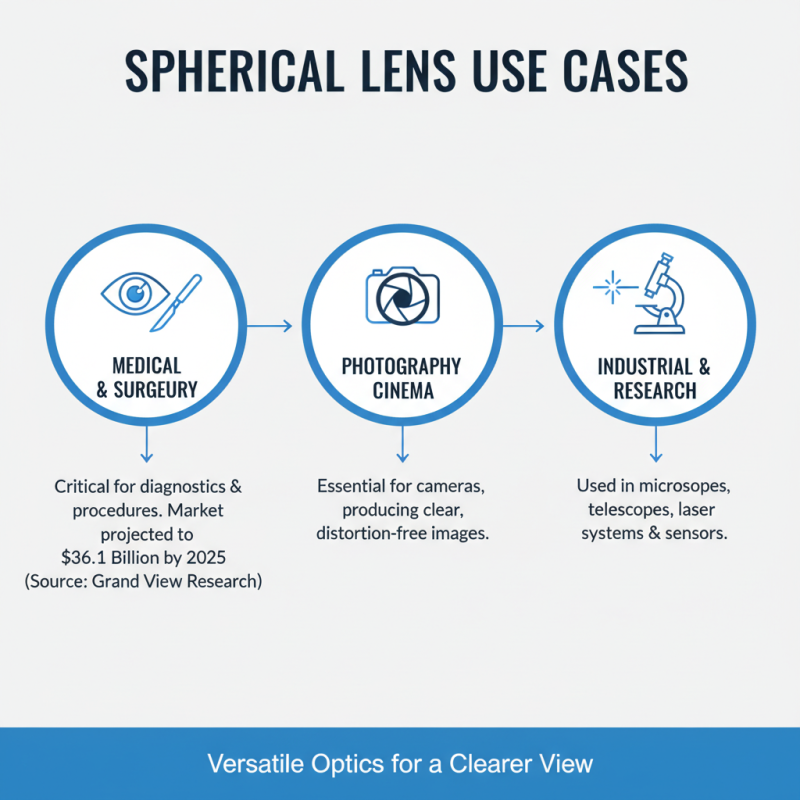
Spherical lenses play a crucial role in multiple industries. The medical field heavily relies on them for imaging and surgical procedures. According to a report by Grand View Research, the global medical optics market is projected to reach $36.1 billion by 2025, emphasizing the need for high-quality optical components.
In the automotive sector, spherical lenses contribute to advanced driver-assistance systems (ADAS). Research from Technavio shows that the automotive ADAS market is expected to grow at a compound annual growth rate (CAGR) of 18% from 2021 to 2025. Enhanced visibility and safety features depend on precise optical design. Yet, there remain challenges in integrating these technologies effectively.
Spherical lenses are also pivotal in consumer electronics. According to the Consumer Technology Association, the global market for optical components is set to exceed $50 billion by 2024. However, quality control issues can impact overall performance. Manufacturers must continuously strive for improvement in lens fabrication techniques to meet consumer demands.
Comparing Spherical Lenses with Other Lens Types
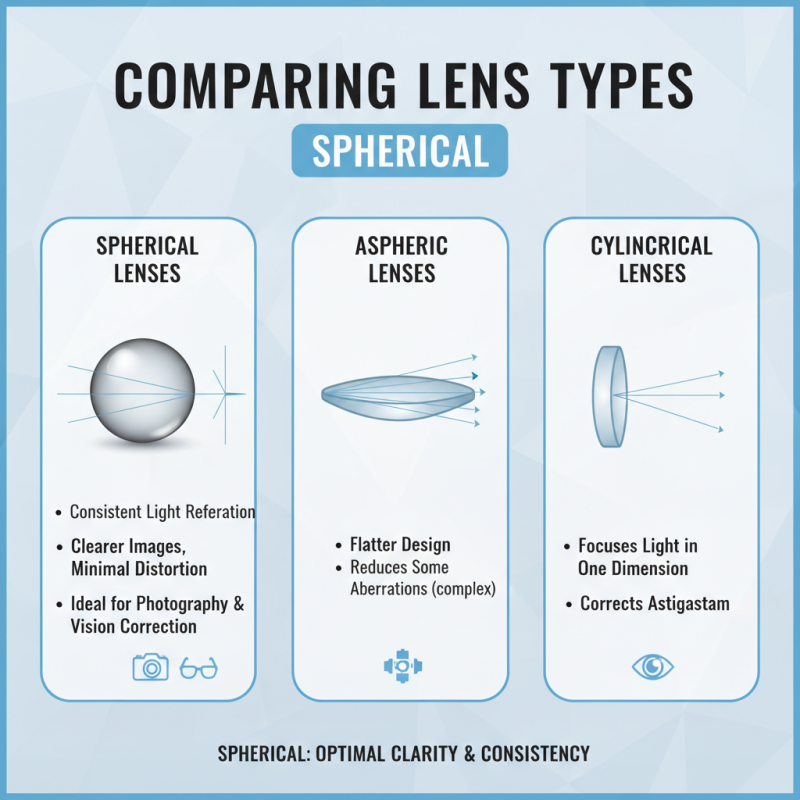
When considering optical needs, selecting the right lens type is crucial. Spherical lenses stand out due to their unique shape, allowing for consistent light refraction. They often provide clearer images and minimal distortion compared to other lens types like aspheric or cylindrical lenses. This consistency makes them ideal for applications such as photography and vision correction. Spherical lenses are designed to focus light effectively, enhancing visual quality across various settings.
In contrast, aspheric lenses can address certain aberrations but may come with a higher cost and complexity. These lenses offer fewer distortions at the edges. However, they may require specific fittings, which can be a challenge for some users. Cylindrical lenses mainly correct astigmatism but aren't ideal for all general applications. Users should consider their specific needs when choosing between these options.
**Tips:** Always test lenses in real-world scenarios. Comfort and usability can differ significantly. Consider your specific visual needs when selecting lenses. Choosing the right lens can greatly influence image quality or visual comfort.
Factors to Consider When Selecting Spherical Lenses for Your Needs
Choosing a spherical lens for optical needs involves several important factors. The curvature of the lens is key. A steeper curve can focus light more effectively but may limit the field of view. Consider how this curvature aligns with your specific requirements. If you need a wide field, a flatter lens may be preferable despite a potential reduction in focus precision.
Another consideration is material. Glass and plastic both have unique benefits. Glass generally offers superior optical clarity and scratch resistance. However, plastic lenses can be lighter and more impact-resistant, making them suitable for various applications. Your choice should reflect the specific demands of your project, whether it's enhancing aesthetics or maximizing durability.
Finally, think about coating options. Anti-reflective coatings can significantly improve light transmission. However, they may require more maintenance, as they are prone to smudging. Reflect on how much care you're willing to give your lenses. Balancing these factors will help you make an informed decision.
Comparative Analysis of Spherical Lens Applications