How to Choose the Right Spherical Lens for Your Needs?
Choosing the right spherical lens is crucial for achieving optimal results in various applications. Renowned optical engineer Dr. James Hawthorne once said, “The right lens can completely transform your vision.” This highlights the importance of selecting the appropriate spherical lens for your specific needs.
Spherical lenses come in different shapes and materials. Each type serves distinct purposes. Whether for photography, lasers, or eyeglasses, understanding their characteristics is vital. For instance, a thicker lens might offer more magnification but can distort images. On the other hand, a thinner lens provides a lighter option, often at the expense of clarity.
Many users overlook the lens coating. Anti-reflective coatings can enhance performance, especially under bright conditions. However, they might not be necessary for every application. It is essential to weigh your specific requirements against any features that seem appealing. Inadequate research can lead to suboptimal choices, affecting overall performance. Always consider practical needs over trendy features.

Understanding the Basics of Spherical Lenses
Spherical lenses are vital in various applications, from eyeglasses to cameras. Understanding their basics is crucial to making informed choices. A spherical lens is curved outward or inward, affecting how it focuses light. This curvature determines the lens's focal length, which is essential for image clarity.
According to a recent industry report, demand for spherical lenses has grown by 25% in the last five years. This increase is driven by advancements in optical technologies. However, not all spherical lenses are created equal. Different materials and coatings impact light transmission and durability. Users often overlook these factors, leading to suboptimal performance.
Selecting the right spherical lens involves considering individual needs. For instance, a lens with a higher refractive index may reduce thickness but can increase cost. Changes in lens design can also influence comfort for extended use. Paying attention to these details can make a significant difference in quality.
Reflection is vital here; often, consumers focus too much on price rather than long-term benefits.
Identifying Your Specific Optical Needs
Choosing the right spherical lens starts with understanding your optical needs. Are you looking for a lens for photography, eyewear, or scientific tools? Each application demands different specifications. For instance, photography lenses often require particular coatings for color accuracy. Think about the environment where you will use the lens. Poor lighting might need a faster aperture for better performance.
Keep in mind the focal length that fits your purpose. A shorter focal length can provide a wider view, useful in landscape photography. Longer lengths, however, are better for portraits. Consider the weight and size as well. Heavy lenses can be cumbersome, especially if you move around a lot. Test lenses if possible; they feel different in real-world conditions. Recognizing what feels right is essential, yet many overlook this in their initial research.
How to Choose the Right Spherical Lens for Your Needs?
Identifying Your Specific Optical Needs
| Lens Type |
Focal Length (mm) |
Diameter (mm) |
Applications |
Coating Type |
| Convex Lens |
50 |
25 |
Magnifying Glass, Laser Systems |
Anti-Reflective |
| Concave Lens |
75 |
30 |
Diverging Beam, Optical Instruments |
UV Protection |
| Aspheric Lens |
100 |
30 |
High-Resolution Imaging, Cameras |
Anti-Fog |
| Bi-convex Lens |
60 |
40 |
Projection Systems, Optical Devices |
Multi-Layer Coating |
Evaluating Lens Material and Coating Options
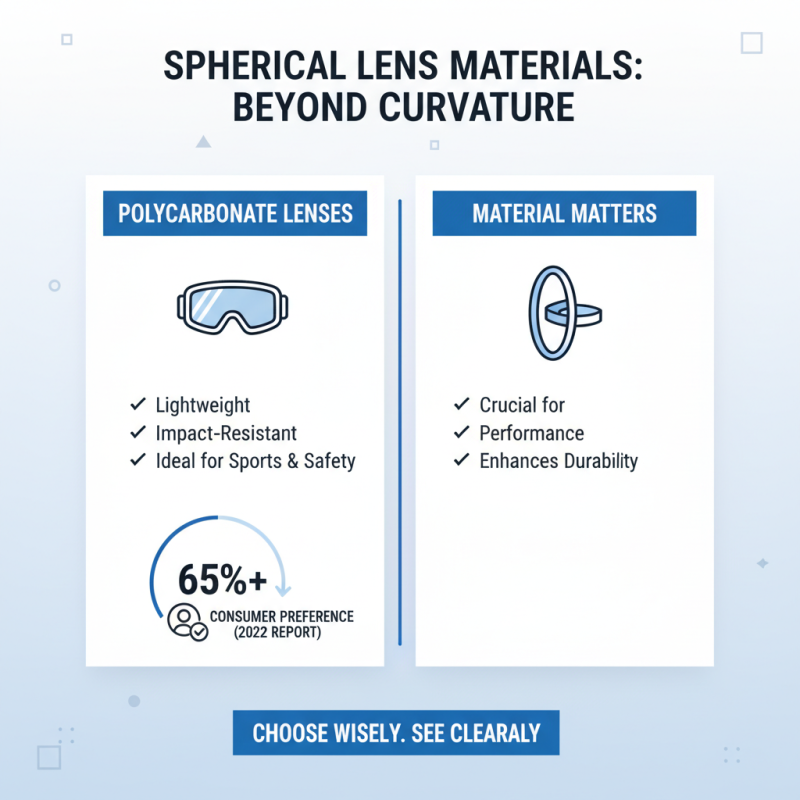
Choosing the right spherical lens goes beyond just curvature. The lens material plays a crucial role in performance and durability. In recent years, polycarbonate lenses have become popular. They are lightweight and impact-resistant, making them ideal for sports and safety eyewear. According to a 2022 industry report, over 65% of consumers prefer polycarbonate for these reasons.
Coating options are equally important. Anti-reflective coatings reduce glare and enhance visual clarity, particularly in bright light. A study found that lenses with anti-scratch coatings last 30% longer than those without. However, the coatings can be susceptible to wear and tear over time. Users often overlook the potential for damage, especially in less durable options.
Some might prefer glass lenses due to superior optical quality. But they are heavier and more prone to shattering. Evaluating your personal needs, like lifestyle and usage, is essential. Consider the trade-offs carefully. Every choice has its downsides, and finding a balance is key in lens selection.
Comparing Lens Curvature and Focal Length
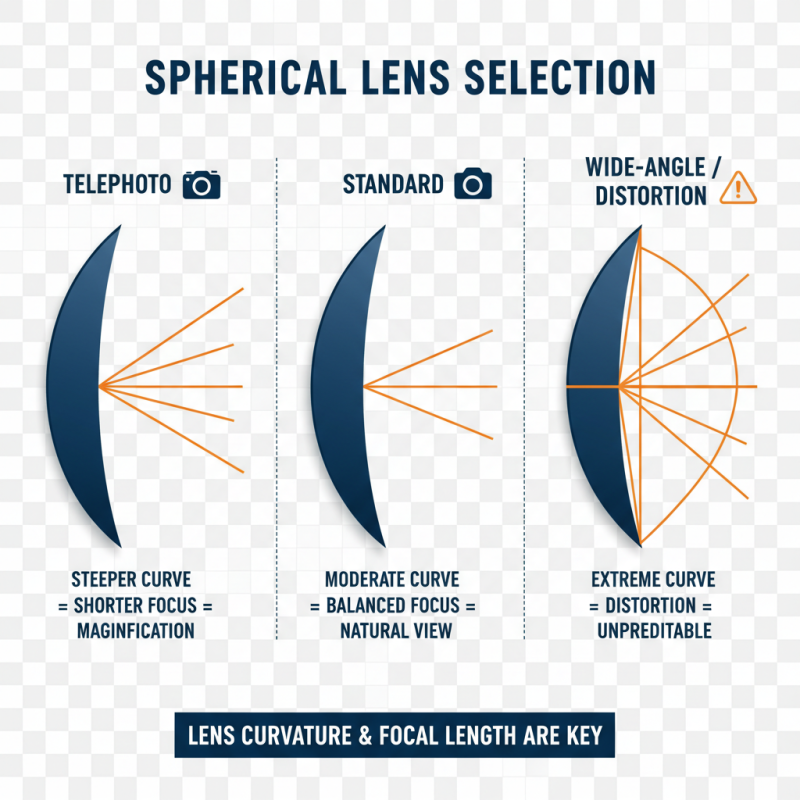
When selecting a spherical lens, lens curvature and focal length are critical factors. The curvature determines how light is refracted. A steeper curve can focus light more closely, perfect for telephoto photography. However, very steep curves can also introduce distortion, which can be problematic in certain applications. This can lead to unexpected results and frustrations.
Focal length plays a significant role as well. It dictates the distance from the lens to the point where light converges. A short focal length means a wider view, while a longer focal length gives you a closer look. However, longer lenses can also amplify camera shake, making stability more crucial. You may find that the right choice isn't always the most straightforward. Sometimes, a lens with a longer focal length might seem appealing, but it can become cumbersome in practical use.
In the end, it's about balancing these factors. Testing different lenses can help you identify what suits your needs. There could be a perfect lens out there that might not be obvious at first. It's essential to reflect on what you truly need from your equipment.
Considering Compatibility with Existing Optical Equipment
When selecting a spherical lens, compatibility with existing optical equipment is crucial. Consider the specifications of your current setup. Check the diameter, focal length, and mounting system of your lenses. An incompatible lens can lead to subpar performance. It may not fit properly, affecting alignment and clarity.
Assess how the new lens will work with your existing lenses and cameras. This can be tricky. Different brands might have unique designs. A lens that fits one camera may not fit another. Test it out if possible. Ensure it meets your needs for light transmission and distortion levels.
Compatibility issues can arise unexpectedly. Dimensions may seem right, but optical performance might still suffer. This aspect is often overlooked in the selection process. Seeking advice from other users may help. Collecting their experiences can guide you in making the right choice. Be ready to reconsider your options if the first pick doesn’t perform well.
How to Choose the Right Spherical Lens for Your Needs?
This chart displays the compatibility scores of various spherical lens types with existing optical equipment. Higher scores indicate better compatibility, which is crucial when selecting the right lens for specific optical needs.