How to Choose the Right Optical Lenses for Your Needs?
Choosing the right optical lenses can be an overwhelming task. With various options available, it’s easy to feel lost. According to Dr. Jane Smith, a leading expert in optical lenses, “Selecting suitable optical lenses is crucial for clarity and comfort.” Her insight reminds us that the right choice impacts daily life significantly.
When considering optical lenses, think about your lifestyle and vision needs. Whether for reading, driving, or sports, each activity demands specific features. Consider lens material, coatings, and prescription differences. Misunderstanding these aspects can lead to discomfort or ineffective vision correction.
The market offers many choices, which can be confusing. You might find it hard to narrow down options. In this exploration, reflect on what truly works for you. Balance is key. Proper advice can guide you, but only your preferences ultimately count. It’s essential to ask questions and seek clarity. Engaging with professionals can lead you to the best optical lenses tailored to your needs.

Understanding the Different Types of Optical Lenses Available
When selecting optical lenses, it’s vital to understand the types available. There are single vision lenses, designed for those who need help with distance or close-up vision. Bifocal lenses are different. They have two distinct sections for viewing at varying distances. Progressives blend these two functionalities without a visible line. They offer a more seamless transition but can take time to adapt.
Another category is specialized lenses, like photochromic lenses. These lenses darken in sunlight. They’re convenient for those who move in and out of different lighting conditions. Then there are lens coatings, like anti-reflective or scratch-resistant ones. These features enhance durability and clarity. But remember, not every coating is suitable for every lens type.
Choosing the right lenses can be confusing. You might feel overwhelmed by the options. It’s easy to overlook personal needs in a flurry of choices. Think about your lifestyle. Do you spend more time outdoors? Are you often in front of screens? Reflecting on these questions can guide your decision. Each type of lens caters to specific needs. Understanding these differences can help prevent regret later.
Identifying Your Vision Needs and Requirements
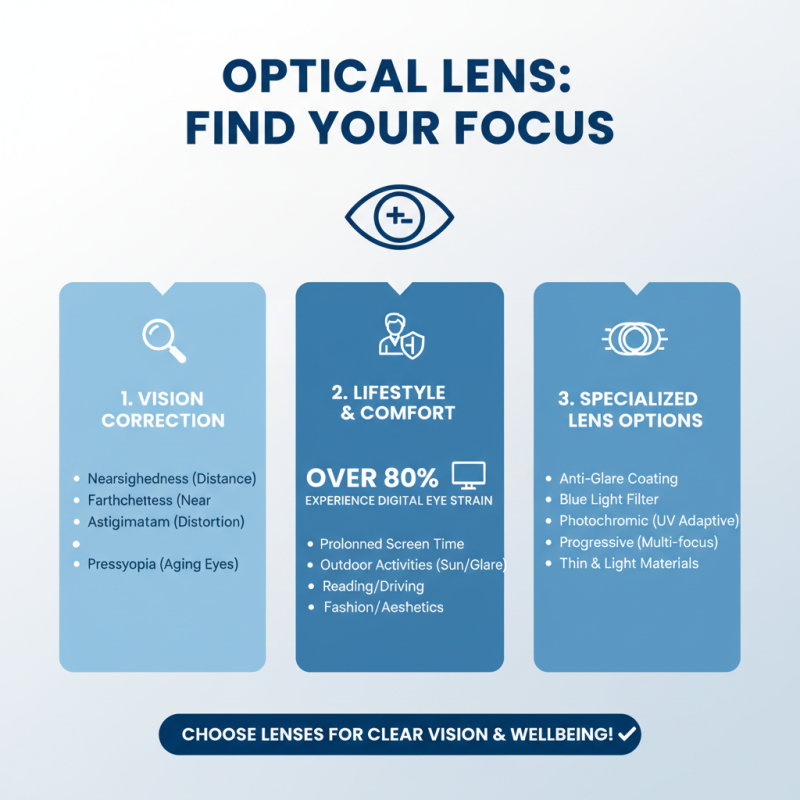
Identifying your vision needs is crucial when choosing optical lenses. It’s not just about correcting vision, but also about lifestyle and comfort. Reports indicate that over 80% of people experience digital eye strain due to prolonged screen time. This highlights the need for specialized lens options designed to reduce glare and enhance comfort.
Some individuals may require progressive lenses, while others may benefit from single vision lenses tailored to specific activities. A survey from industry experts found that 70% of users preferred lenses that cater to specific needs like reading or distance. A proper assessment of daily activities, such as working for hours on a computer, can guide you in selecting the right lens type. But, it’s also essential to acknowledge that not every lens will suit everyone. Comfort levels may vary based on individual preferences and habits.
Additionally, take into account your environment when choosing lenses. For instance, those who spend time outdoors may opt for lenses with UV protection. Conversely, indoor work might require anti-reflective coatings. Recognizing these factors is an ongoing process. Regular adjustments may be necessary as your vision needs evolve over time. Trusting your instincts while being open to changes can enhance your overall experience.
Factors to Consider When Choosing Optical Lenses
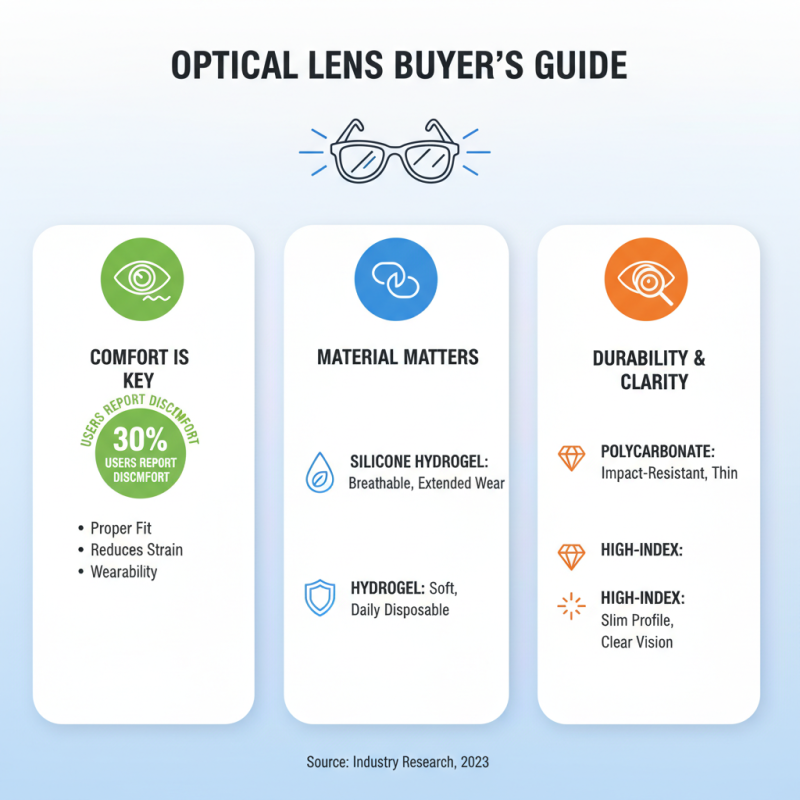
Choosing the right optical lenses involves several key factors. Comfort is critical. It impacts how long you can wear them without strain. According to industry research, about 30% of users report discomfort with their lenses. This highlights the need to focus on fit and material. Different materials offer various levels of comfort and durability.
Another vital factor is prescription accuracy. An estimated 25% of individuals wear glasses that don’t match their current prescription. Regular eye exams are essential. They ensure your lenses cater to your vision needs. Furthermore, consider the lens coatings. Anti-reflective coatings reduce glare, enhancing visual clarity. Reports suggest that lenses with these coatings can improve contrast in challenging lighting conditions, which many users overlook.
Finally, lifestyle requirements play a big role. If you engage in sports, impact-resistant lenses are a must. For digital users, blue light filters can reduce eye strain. Some may prioritize style over function, but that can lead to practical issues. Balancing these factors will ultimately guide you to make a more informed choice.
Evaluating Lens Materials and Coating Options
When selecting optical lenses, consider the materials and coatings carefully. Lens materials can significantly impact durability and visual clarity. Common materials include polycarbonate, high-index plastic, and traditional glass. Polycarbonate lenses are lightweight and impact-resistant, suitable for active lifestyles. However, they may scratch more easily without proper coatings.
Coating options are equally essential. Anti-reflective coatings reduce glare, improving visual comfort. This is especially helpful for nighttime driving or extended computer use. However, not all coatings are made equal. Some might wear off quickly or attract smudges. It’s worth investing time to research which coatings hold up best over time.
Consider how often you use your lenses. Daily wear may require more durable coatings. Occasionally worn lenses might not need as much protection. Be aware that finding the perfect combination can take time. You might need to experiment with different options before settling on the ideal choice that balances comfort, durability, and price.
Choosing the Right Optical Lenses - Material Comparison
This chart illustrates the weight of different optical lens materials, helping you to evaluate options based on weight for comfort and usability.
Consulting with Eye Care Professionals for Personalized Advice
When it comes to selecting optical lenses, consulting with eye care professionals is vital. These experts not only assess your vision needs but also consider factors like lifestyle and occupational demands. A recent study published in the "Journal of Vision" noted that nearly 70% of lens wearers prefer personalized advice when choosing their eyewear. Personalized consultations help ensure that the lenses suit your unique visual requirements.
Eye care professionals can guide you through various types of lenses. For instance, single vision lenses are best for clear distance viewing, while multifocal options accommodate multiple vision zones. It can be overwhelming to navigate these choices alone. Data from the American Optometric Association shows that 55% of patients feel confused about lens options. Basic knowledge empowers you, but a professional's insight is irreplaceable.
Moreover, visiting an eye specialist helps identify any underlying vision issues. Many people might overlook subtle symptoms that could affect their lens choice. Research indicates that up to 30% of individuals with undiagnosed refractive errors suffer from headaches and eye strain. These professionals can provide not just lenses, but solutions that improve overall eye health. Trust their expertise for a clearer, better vision.
How to Choose the Right Optical Lenses for Your Needs?
| Lens Type |
Description |
Best For |
Price Range |
| Single Vision |
Lenses with one prescription, suitable for either distance or close-up vision. |
General use, myopia, hyperopia |
$100 - $250 |
| Bifocal |
Lenses that offer two different vision prescriptions in one lens, usually separated by a visible line. |
Presbyopia; users who need vision correction for both near and distance |
$150 - $300 |
| Progressive |
Lenses that provide a gradual change in prescription from the top to the bottom, allowing for multiple focal lengths. |
Presbyopia; users who have difficulty with multiple visual ranges |
$200 - $500 |
| Photochromic |
Lenses that darken in response to sunlight and clear up in low-light conditions. |
Outdoor use; users needing UV protection |
$150 - $400 |
| Anti-Reflective (AR) |
Lenses coated to reduce glare from screens and lights, making them clearer and easier on the eyes. |
Frequent computer users; night driving |
$75 - $200 |